 how-to
How to Improve Focus Working: 7 Proven Strategies
Table of Contents
- Why You Can't Focus at Work (And What's Actually Causing It)
- How to Stay Focused in an Office: A Step-by-Step Framework
- Deep Work Techniques That Actually Work
- Managing Workplace Distractions Without Isolating Yourself
- How to Improve Focus Working From Home vs. a Private Office
- Aligning Your Workday With Your Natural Energy Rhythms
- Common Mistakes That Sabotage Your Focus
- Frequently Asked Questions
Last Updated: September 19, 2026
Why You Can't Focus at Work (And What's Actually Causing It)
Most people blame willpower when their focus slips. The real culprit is usually the environment, not a lack of discipline. This guide from Kiwi Offices breaks down how to improve focus working, even when your day is full of interruptions.
The Real Cost of Constant Distraction
Every time you switch tasks, your brain pays a tax.
The pattern looks like this:
- A notification pops up
- You answer it
- You lose your place in the original task
- You spend minutes getting back on track
Signs Your Focus Is Slipping
Watch for these warning signs:
- You reread the same paragraph three times
- You jump between tasks without finishing any
- You feel busy but get little done
- You check your phone without thinking
- You feel drained by mid-afternoon
If that sounds familiar, your focus habits need a reset. The fix starts with understanding what's stealing your attention.
How to Stay Focused in an Office: A Step-by-Step Framework
Staying focused in an office takes a system, not just good intentions. The three steps below help you find your distractions, fix your space, and protect your best working hours.
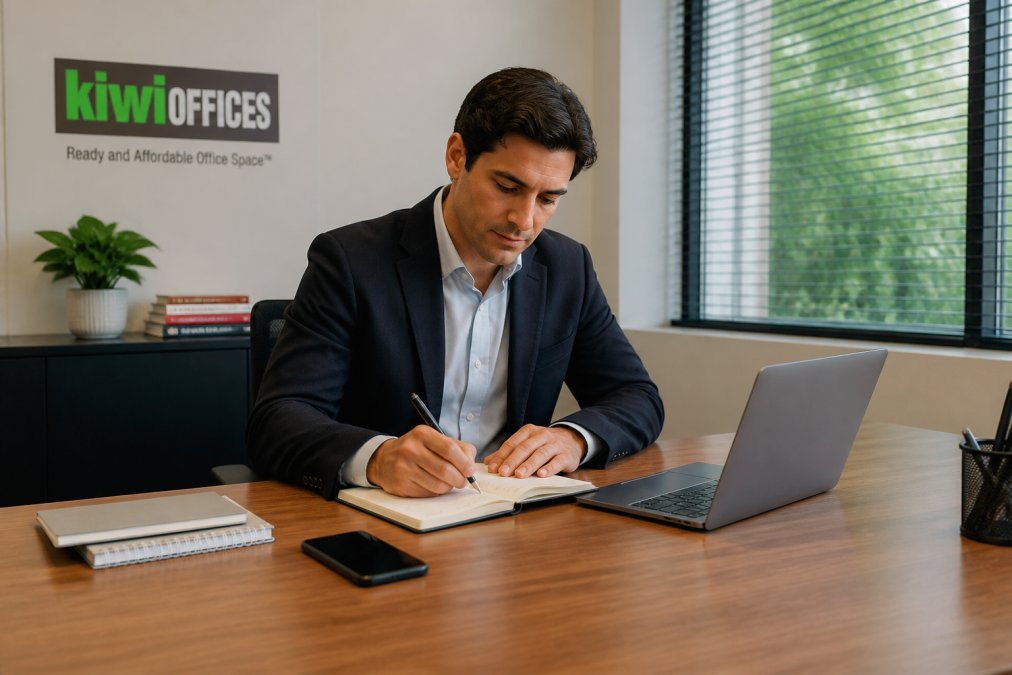
Step 1: Audit Your Distractions for One Week
You can't fix what you haven't measured. For one week, write down every time you lose focus.
Track three things:
- What pulled you away
- What time it happened
- How long it took to recover
Step 2: Set Up Your Environment for Concentration
Your desk sends your brain signals. A cluttered, noisy space says "stay alert." A calm, ordered space says "settle in."
Try these changes:
- Clear everything off your desk except the current task
- Turn your phone face-down or in a drawer
- Use noise-cancelling headphones if your office is loud
- Keep water nearby so you don't get up as often
Small changes here pay off all day.
Step 3: Use Time Blocking to Protect Your Best Hours
Time blocking means giving each task its own slot on your calendar.
Deep Work Techniques That Actually Work
Deep work is the state of full concentration on one demanding task without distraction. Cal Newport, a computer science professor at Georgetown, popularized the term in his 2016 book Deep Work, arguing that the ability to concentrate without distraction is becoming both rarer and more valuable. The methods below are the most reliable ways to reach that state, and each one works for a different reason.
The Pomodoro Method vs. 90-Minute Blocks
The Pomodoro method breaks work into 25-minute sprints with 5-minute breaks (The Pomodoro Technique). After four rounds, you take a longer break of 15 to 30 minutes. The short interval lowers the activation energy to start, because you're only committing to 25 minutes. That's why it works so well when motivation is low.
| Method | Best For | Work Interval | Break | Why It Works |
|---|---|---|---|---|
| Pomodoro | Short tasks, low motivation, procrastination | 25 minutes | 5 minutes | Lowers the cost of starting |
| 90-minute blocks | Deep, complex, creative work | 90 minutes | 15-20 minutes | Aligns with ultradian rhythms |
| Time blocking | Scheduling the whole day | Variable | Variable | Removes decision fatigue |
Single-Tasking: The Counterintuitive Productivity Boost
Multitasking feels productive. It isn't.
Your brain can't truly do two demanding things at once. It switches back and forth, and each switch costs you time and mental energy. Researchers call the leftover attention from Task A that lingers while you're on Task B attention residue. Sophie Leroy, a professor at the University of Washington Bothell, documented the effect in a 2009 study: people who switched tasks without finishing the first one performed worse on the second, even when the first task was done.
A concrete way to practice it:
- Pick one task and write it on a sticky note.
- Close every other tab, document, and chat window.
- Put your phone in another room, not face-down on the desk.
- When a distracting thought arrives, write it on a "later" list instead of acting on it.
- Work until the task is done or you hit a natural stopping point.
The Two-Hour Rule for Your Hardest Task
A common pattern among knowledge workers is to reserve the first two hours of the workday, before email, before Slack, before meetings, for the single hardest thing on the list. The reason is simple: your prefrontal cortex, which handles planning and self-control, is freshest early. Every decision you make drains it a little.
Managing Workplace Distractions Without Isolating Yourself
You can cut distractions without becoming the person nobody talks to.
A few practical moves:
- Agree on "quiet hours" with your team
- Use headphones as a visible signal
- Batch questions into one check-in instead of constant pings
- Take real breaks so you're not antisocial all day
How to Improve Focus Working From Home vs. a Private Office
Working from home and working in a private office create very different focus problems. Knowing which one you face helps you fix it faster.
Remote Work Focus Challenges
Home offers comfort, and comfort can kill focus.
Common home problems include:
- Family members who don't know you're working
- Chores that call your name
- A blurry line between work and rest
- No separation between "office" and "living room"
Many remote workers find that without a dedicated space, the brain never fully shifts into work mode.
Why a Dedicated Office Space Changes Everything
A dedicated office tells your brain it's time to work.
Aligning Your Workday With Your Natural Energy Rhythms
Most focus advice assumes everyone peaks in the morning. That's wrong for roughly a quarter of the population. Your chronotype, your body's natural preference for when to sleep and when to be alert, determines when your best hours actually land. Fighting your chronotype is one of the most common and least recognized reasons focus fails.
The Three Chronotypes
Sleep researchers generally group people into three chronotypes:
- Morning types (larks). Peak alertness in the early to mid-morning. Roughly 25% of people.
- Intermediate types. Peak in the late morning to early afternoon. The largest group, around 50%.
- Evening types (owls). Peak in the late afternoon or evening. Roughly 25% of people.
Chronotype is partly genetic and shifts with age. Teenagers skew late; older adults skew early. You can't will yourself into a different chronotype, but you can schedule around the one you have.
How to Find Your Peak Windows
For one week, rate your focus on a 1-to-5 scale every two hours during your workday. Note what you were doing and how alert you felt. By day five, a pattern emerges.
| Time | Energy | Best Task Type |
|---|---|---|
| 8-10 a.m. | Rising | Planning, email triage, easy wins |
| 10 a.m.-12 p.m. | Peak | Hard analytical or creative work |
| 12-2 p.m. | Dip | Lunch, routine admin, low-stakes tasks |
| 2-4 p.m. | Rebound | Collaboration, meetings, brainstorming |
| 4-6 p.m. | Declining | Wrap-up, planning tomorrow, easy tasks |
The Post-Lunch Dip Is Real, and Predictable
The early-afternoon slump isn't laziness. It's a normal part of the circadian rhythm, and it happens whether or not you eat a heavy lunch (though a large meal makes it worse). The dip typically runs from about 1 p.m. to 3 p.m.
- Schedule routine, low-cognition work, expense reports, inbox cleanup, filing.
- Take a short walk outside. Daylight helps reset the rhythm.
- If you can, take a 10-to-20-minute nap. Even a brief rest improves afternoon alertness.
- Avoid scheduling your hardest task here. You'll do it badly and feel worse about it.
Protect Your Peak, Don't Waste It
The most common mistake is giving your peak hours to your inbox. Email is other people's priorities. Your peak hours are your scarcest resource, spend them on the work only you can do.
Common Mistakes That Sabotage Your Focus
Even good focus habits fall apart when you make these mistakes.
- Chasing every new app. Tools don't fix habits. Pick one method and stick with it.
- Skipping breaks. Pushing through fatigue backfires. Short breaks keep you sharp.
- Working in a chaotic space. Noise and clutter drain focus before you notice.
- Never saying no. Every yes to a distraction is a no to your real work.
- Ignoring sleep. No focus system works on too little rest.
Frequently Asked Questions
How do I improve my ability to focus at work?
Start by identifying what breaks your focus most often. Track your distractions for one week, then address the top three. Set up a dedicated workspace free from noise and visual clutter. Use time blocking to assign specific tasks to specific hours. Try the Pomodoro method: 25 minutes of work, 5 minutes of rest. Most people see improvement within two weeks of consistent practice.
What are the signs of poor focus in a professional setting?
Common signs include rereading the same email multiple times, jumping between tasks without finishing any, feeling drained by mid-morning, and needing constant background noise to stay on task. You might also notice more errors in your work or take longer than expected to complete routine assignments. These signals usually point to cognitive overload, poor workspace setup, or unmanaged digital interruptions.
How does a dedicated office space improve concentration?
A private office removes the unpredictable noise and interruptions that come with shared or home environments. When your brain associates a specific physical space with focused work, it enters concentration mode faster. Unlike co-working or working from home, a dedicated suite gives you control over lighting, temperature, and foot traffic. This consistency reduces the mental effort required to settle into deep work each day.
What are the best techniques to minimize workplace distractions?
Silence non-essential notifications and batch your email checks to two or three times daily. Use a visible signal like headphones or a closed door to tell colleagues you're in focused work. Schedule meetings in blocks rather than scattering them throughout the day. For open offices, book a private room for tasks that require deep concentration. Managing workplace distractions starts with controlling your inputs, not just your willpower.
Focus at work isn't about working harder. It's about removing the friction that pulls you off task, and giving yourself a space and a system that support real concentration. Kiwi Offices offers turnkey furnished private suites, ready-to-use workspaces, and independent offices built for small businesses that need quiet and privacy. Get started with Kiwi Offices and book a tour to see how the right workspace changes your workday.