 how-to
7 Hidden Costs of Office Leases That Surprise Tenants
Last Updated: November 1, 2026
Quick Summary
The hidden costs of office leases go beyond base rent to include operating expenses and CAM charges, property tax and insurance pass-throughs, fit-out and furniture, utilities, and move-in, renewal, and exit fees. Review the lease clause by clause and run a total-cost-of-occupancy worksheet before you sign.
- U.S. office fit-out costs rose 5% year over year, an upfront expense outside your rent check.
- A base year without a CAM cap is an open-ended bill; ask for both in writing.
- A gross-up provision recalculates expenses as if the building were, for example, 95% occupied.
- Holdover penalties commonly charge 150% to 200% of the final month's rent.
- Enterprise tenants over 25,000 square feet cut their footprints by an average of 7.9%.
Table of Contents
- Why the Quoted Rent Is Only Part of Your Office Lease Costs
- Operating Expenses, CAM Charges, and Property Tax Pass-Throughs
- Office Lease Costs Beyond Rent: Fit-Out, Furniture, and IT
- Utilities, Insurance, Repairs, and Maintenance Responsibilities
- Your Office Lease Negotiation Checklist Before You Sign
- Move-In, Renewal, and Exit Costs Most Tenants Forget
- How Flexible Office Lease Terms Cut Unexpected Costs
- Book a Tour and See What Your Monthly Payment Covers
- Frequently Asked Questions
Why the Quoted Rent Is Only Part of Your Office Lease Costs
The quoted rent is not your total occupancy cost.
The hidden costs of office leases rarely appear in the first email. That is the core problem.
According to Canopy Space's analysis of Cushman & Wakefield's 2026 Office Fit Out Cost Guide, U.S. office fit-out costs rose 5% year over year. That is an upfront expense sitting outside your rent check.
Rent is the entry fee, not the total.
Below, we break down each cost category, show you how to review a lease clause by clause, and give you a worksheet you can fill in before you sign. For a fuller picture of what dedicated space actually runs, see our guide to the cost of dedicated office space.
Operating Expenses, CAM Charges, and Property Tax Pass-Throughs
Operating expenses are the landlord's costs of running the building, and most commercial leases pass a share of them to you. Common area maintenance (CAM) charges cover lobbies, hallways, restrooms, parking areas, landscaping, snow removal, and shared systems. Property tax pass-throughs shift the building's tax bill to tenants. Insurance pass-throughs shift the landlord's property and liability premiums.
These charges are commonly left out of quoted rent, which makes them easy to underestimate.
How the Three Clauses Interact
Three clauses decide how much you actually pay, and they only work together:
- Base year: the expense level above which you pay your share. If the base year is 2026 and your lease starts in 2027, you pay only the increase over 2026 expenses, not the full bill.
- Gross-up provision: sets how the landlord adjusts expenses when the building is partly empty. Without a gross-up, a half-empty building can make your per-square-foot share look artificially high because fixed costs are spread over fewer tenants. A gross-up provision recalculates expenses as if the building were, for example, 95% occupied.
- CAM cap: a ceiling on how much CAM charges can rise each year, usually expressed as a percentage increase over the prior year or a cumulative cap over the term.
A base year without a cap is an open-ended bill. A cap without a gross-up can still produce a surprise reconciliation. Ask for both, and ask for the gross-up percentage in writing.
A Worked Example of a CAM Reconciliation
Suppose your suite is 2,000 square feet in a 100,000-square-foot building, so your pro-rata share is 2%. The landlord's total operating expenses for the year are $500,000, but the building is only 80% occupied. Without a gross-up, your share would be 2% of $500,000, or $10,000. With a 95% gross-up, the landlord recalculates expenses as if the building were 95% occupied: $500,000 divided by 80% times 95%, or $593,750. Your 2% share becomes $11,875.
What to Ask For in Negotiation
- A base year that matches your first full year of occupancy, not a year before the building was fully leased.
- A gross-up provision with a stated occupancy floor, commonly 90% to 95%.
- A CAM cap with a stated annual percentage ceiling, plus a carve-out for snow removal, insurance, and utilities if the landlord insists.
- Audit rights that let you review the landlord's expense backup within a set window after reconciliation.
- A list of excluded expenses, capital improvements, leasing commissions, debt service, and landlord marketing costs should not flow through to you.
These are the clauses that separate a predictable occupancy budget from a reconciliation surprise. Review them line by line, not as boilerplate.
Office Lease Costs Beyond Rent: Fit-Out, Furniture, and IT
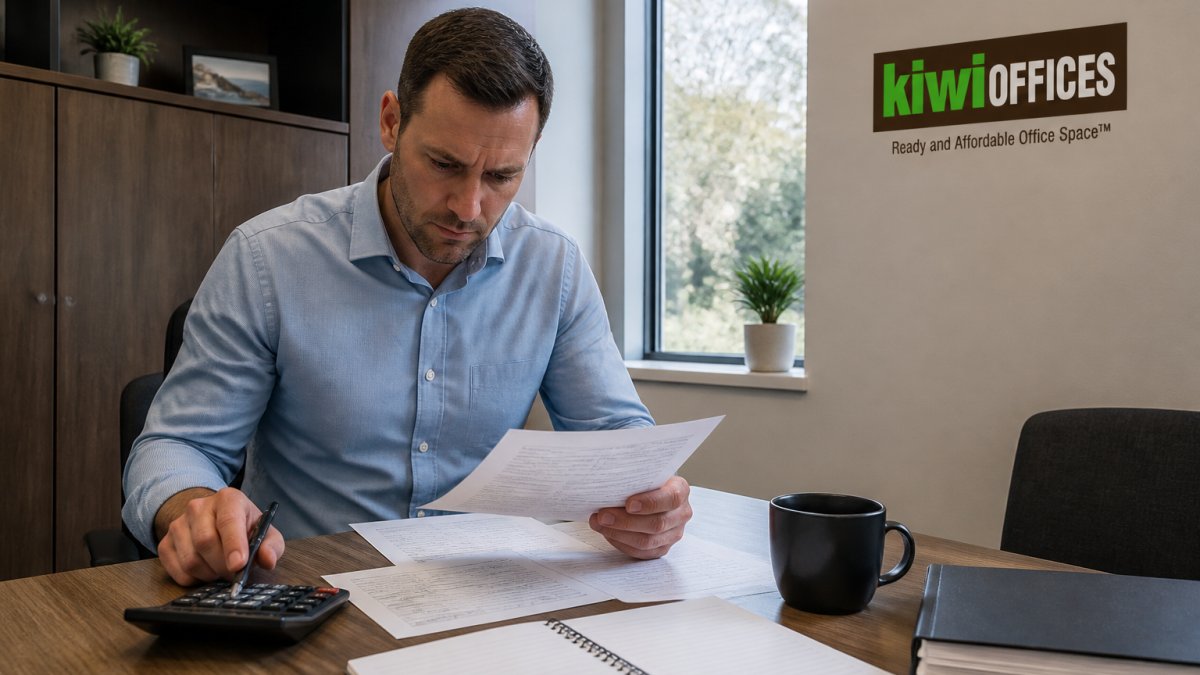
Office lease costs beyond rent usually include three big items: building out the space, furnishing it, and wiring it. Together they can rival a year of rent, and none of them show up in the quoted rate.
Commercial lease tenant improvement costs cover the work that makes a bare space usable. That means walls, flooring, lighting, electrical, and HVAC adjustments.
Furniture and IT provisioning follow. To see what a furnished private suite actually costs per month, see what private business suites cost per month.
What Commercial Lease Tenant Improvement Costs Actually Cover
Tenant improvement costs cover the interior build-out a tenant needs to operate: partitions, finishes, mechanical and electrical work, and code compliance. A landlord allowance may cover part of it, but rarely all.
Watch out: a "turnkey" promise in a lease can still leave you paying for upgrades above the building standard. Get the allowance amount in writing, with a list of what it excludes.
Utilities, Insurance, Repairs, and Maintenance Responsibilities
Utilities, insurance requirements, and repair obligations are the costs tenants most often assume are included. They usually are not.
Utilities may be separately metered or shared and billed back. Ask which, and ask for twelve months of history.
Insurance requirements typically include general liability and property coverage, plus naming the landlord as an additional insured.
Repairs and maintenance split by lease type.
Cleaning, reception services, parking fees, and amenity charges can each be separate line items.
Your Office Lease Negotiation Checklist Before You Sign
Use this office lease negotiation checklist to turn vague promises into written terms. Each item below maps to a real cost.
- Base rent and annual rent escalation schedule, in writing
- Operating expense base year and gross-up provision
- CAM cap, with a stated annual percentage ceiling
- Property tax pass-through language and your share
- Insurance requirements and estimated premium
- Repair and maintenance split by item
- Tenant improvement allowance and what it excludes
- Parking, cleaning, and amenity charges
- Renewal terms, notice periods, and holdover penalties
- Early termination rights and exit costs
Run the numbers on a total-cost-of-occupancy worksheet before you negotiate. Add base rent, your CAM share, taxes, insurance, utilities, and amortized fit-out into one annual figure. Then divide by usable square feet.
That number, not the quoted rate, is your real cost per square foot.
Move-In, Renewal, and Exit Costs Most Tenants Forget
Move-in, renewal, and exit costs are the third wave of hidden costs of office leases, and they hit at the worst moments: when you are least able to negotiate and most exposed to the lease terms you signed years earlier. Most guides stop at ongoing rent. Operational expenses often bleed into the digital infrastructure as well, where hidden IT contract costs frequently mirror the same rigid, long-term commitments that trap tenants in unfavorable office space.
Move-In Costs
- Security deposit: the amount varies by lease, so confirm it in the agreement. Ask whether it can be reduced after a track record of on-time payment.
- Legal and brokerage fees: tenant-side lease review costs vary with the complexity of the lease. Confirm who pays the broker before you tour.
- Setup and connection costs: utility deposits, internet installation, signage, and any build-out items outside the tenant improvement allowance.
- Rent commencement vs. possession date: the gap between the two is free rent only if the lease says so. Confirm the abatement period in writing.
Renewal Costs
- Escalation clauses that reset rent upward at renewal, often at a fixed percentage or a market-rate reset. Ask for the renewal formula in the original lease, not a handshake.
- Renewal option notice windows that vary by lease. Miss the window and the option may be lost.
- Refreshing the space: paint, carpet, and furniture replacement at renewal are tenant costs unless the lease says otherwise.
Exit Costs
- Restoration clauses can require you to undo your own improvements, removing partitions, capping plumbing, restoring flooring, even when the next tenant would keep them. Negotiate a list of approved improvements that stay.
- Holdover penalties commonly charge 150% to 200% of the final month's rent if you stay past the term. Confirm the exact multiplier and any grace period.
- Early termination fees vary by lease and may include remaining rent and other unrecovered costs. Ask for the formula, not just the right.
- Final reconciliation: the landlord can bill you after you leave for CAM true-ups, utilities, and damage. Keep the deposit and reconciliation timeline in the lease.
Enterprise tenants occupying more than 25,000 square feet cut their footprints by an average of 7.9%, according to Canopy Space's reporting via KEYT/Stacker. That is a lot of paid-for, underutilized space, and it compounds at exit when restoration and holdover costs apply to space you never fully used.
For small teams, the same risk applies at smaller scale. If you lease 1,500 square feet and use 900, you pay for 600 square feet of nothing, and you may pay to restore it on the way out. Our breakdown of short term office lease advantages for small business explains how shorter commitments reduce renewal and exit exposure.
How Flexible Office Lease Terms Cut Unexpected Costs
Flexible office lease terms replace variable charges with a predictable monthly payment.
With a traditional office lease, you absorb fit-out, CAM reconciliations, tax pass-throughs, and maintenance surprises.
Here is how we would frame the comparison:
| Cost Category | Traditional Lease | Flexible Lease |
|---|---|---|
| Base rent | Quoted per square foot | Bundled monthly |
| Fit-out and build-out | Tenant-funded | Included |
| Furniture and IT | Tenant-funded | Furnished |
| CAM and tax pass-throughs | Reconciled annually | Bundled |
| Utilities and cleaning | Often separate | Bundled |
| Lease term | Multi-year | Short, renewable |
| Exit costs | Restoration possible | Minimal |
There is a trade-off. Flexible space can cost more per square foot than raw base rent.
You can see exactly what a turnkey monthly payment covers on our small office space with shared conference rooms and free internet page.
Book a Tour and See What Your Monthly Payment Covers
The best way to test any cost estimate is to walk the space and read the terms.
Kiwi Offices provides turnkey furnished offices and private individual business suites, not co-working or shared space. Confirm with Kiwi Offices what each suite includes before you sign.
Request a quote from Kiwi Offices to see current pricing for your needs. Contact our team to book a tour and walk through what is included.
Frequently Asked Questions
What costs are not included in office rent?
Base rent usually excludes operating expenses, common area maintenance (CAM) charges, property tax pass-throughs, insurance, utilities, repairs, and janitorial service. Fit-out, furniture, and IT provisioning are typically separate upfront costs. Ask for a full list of charges before signing so your office lease costs reflect the total occupancy cost, not just the quoted rent per square foot.
How do you calculate the total cost of leasing office space?
Add base rent, estimated operating expenses and CAM, property tax pass-throughs, insurance, utilities, and maintenance to get an annual occupancy cost, then divide by usable square feet for a true cost per square foot. Include one-time costs like tenant improvements, furniture, and move-in fees. Build in a cushion for annual reconciliations, since variable charges can rise after the first year.
How can flexible office lease terms reduce unexpected costs?
Flexible office lease terms typically bundle utilities, furnishings, maintenance, and reception into one predictable payment, which removes the reconciliation surprises common in traditional commercial leases. Shorter terms also limit exposure if your headcount changes.
How much should you budget for office space beyond base rent?
Budget for operating expenses, CAM, taxes, and insurance on top of quoted rent, and budget separately for fit-out, furniture, and IT if you take a traditional lease. Because pricing varies by space, term, and inclusions, request a written breakdown of every charge and confirm what is bundled before you commit.