 ultimate-guide
Cost of Dedicated Office Space: 2026 Pricing Guide
Table of Contents
- What Drives the Cost of Dedicated Office Space
- Dedicated Desk vs Private Office vs Hot Desk Pricing
- Hidden Costs of Office Leasing That Blow Up Your Budget
- Office Space Square Footage Requirements and Price Per Seat
- Private Office Lease vs Coworking Membership: Which Costs Less?
- How to Negotiate Office Rent and Avoid Overpaying
- Frequently Asked Questions
Last Updated: September 18, 2026
What Drives the Cost of Dedicated Office Space
The cost of dedicated office space is the total amount a business pays to lease a private, self-contained workspace, and it hinges on three variables: location, building class, and lease term.

Location, Class, and Lease Term
Location sets the floor: a suite near a major transit hub or dense commercial corridor commands more than the same square footage two miles off the main road. Building class adjusts that baseline. Class A properties carry premium finishes, modern infrastructure, and on-site amenities; Class B buildings offer functional space at a lower rate; Class C stock is older and cheaper but often needs tenant investment to reach a professional standard.
Dedicated Desk vs Private Office vs Hot Desk Pricing
These three options sit at different points on the cost and privacy spectrum, and confusing them is the fastest way to overpay.
- Hot desk: An unassigned seat in a shared area. Cheapest entry point, zero privacy, no place to leave belongings or meet a client.
- Dedicated desk: A specific desk reserved for your use, typically in an open or semi-open floor. You get consistency, not confidentiality.
- Private office: A lockable, self-contained suite. Highest cost, but it delivers a professional environment, a business address, and the ability to hold confidential conversations without booking a room.
| Option | Privacy | Setup Cost | Best For | Main Trade-off |
|---|---|---|---|---|
| Hot desk | None | Lowest | Nomads, occasional use | No permanence |
| Dedicated desk | Low | Low | Solo workers, steady routine | No client privacy |
| Private office | High | Moderate | Client-facing businesses | Higher monthly rate |
Hidden Costs of Office Leasing That Blow Up Your Budget
The hidden costs of office leasing are the expenses that never appear in the advertised rate, and they are where budgets quietly break. A quoted monthly figure typically covers base rent only. Everything else is negotiable, variable, or both.
The Line Items That Live Outside Base Rent
Watch for these recurring extras:
- Operating expense (OpEx) pass-throughs, property taxes, building insurance, and common-area maintenance. In a gross lease the landlord absorbs these; in a net lease they flow to you (gross lease | Wex | US Law). Ask which structure you are signing.
- Utilities, metered separately, sub-metered, or estimated and reconciled at year end, a common January surprise.
- Security deposit, often several months of rent, plus any personal guarantee the landlord requires from a young company.
- Parking, charged per space and rarely included in dense commercial corridors.
- Meeting room and conference credits, billed hourly once you exceed the monthly allowance.
- Janitorial, internet, and phone infrastructure, sometimes passed through as operating expenses rather than bundled.
- Build-out, furniture, and signage, if the space is not turnkey. Tenant improvement allowances exist but are negotiated, not standard.
- Insurance, general liability and, for a private suite, often a business owner's policy required as a certificate before move-in.
Building a TCO Number You Can Defend
A workable TCO model has four layers, added in this order:
- Base rent, rate per square foot (or per seat) times the term.
- Recurring pass-throughs, OpEx, utilities, parking, janitorial, internet.
- One-time costs, deposit, build-out, furniture, signage, moving, and any tenant improvement shortfall.
- Soft costs, the value of your own time spent managing vendors, plus the cost of holding a space larger than your team uses.
Furniture Depreciation and the Ownership Question
If you buy your own furniture and build out the space, those assets depreciate on a schedule rather than disappearing as a monthly cost. That changes your cash-flow shape, a large upfront outlay instead of a steady monthly bill, and your tax picture, because depreciable business property is treated differently from rent on a Schedule C or corporate return. A turnkey furnished suite folds furniture and build-out into the monthly rate, simpler to budget but usually costlier over a multi-year horizon.
Office Space Square Footage Requirements and Price Per Seat
Office space square footage requirements vary by use, but the practical benchmark is a range rather than a single number. A private office for one person needs room for a desk, guest seating, and storage; each additional team member adds workspace, circulation, and shared use of meeting and break areas.
Rentable vs. Usable Square Feet and the Load Factor
Commercial leases are almost always quoted in rentable square feet (RSF), which includes your share of building common areas, lobbies, corridors, restrooms, elevator banks, and mechanical rooms. The space you actually occupy is usable square feet (USF). The ratio between them is the load factor (sometimes called the add-on factor): Understanding this distinction is essential when calculating the total surface area requiring renovation, especially since hiring commercial painters often involves budgeting for the full rentable footprint rather than just the private offices.
Planning Benchmarks by Team Size
These are working ranges, not rules, a sales floor and a software team will land in different places:
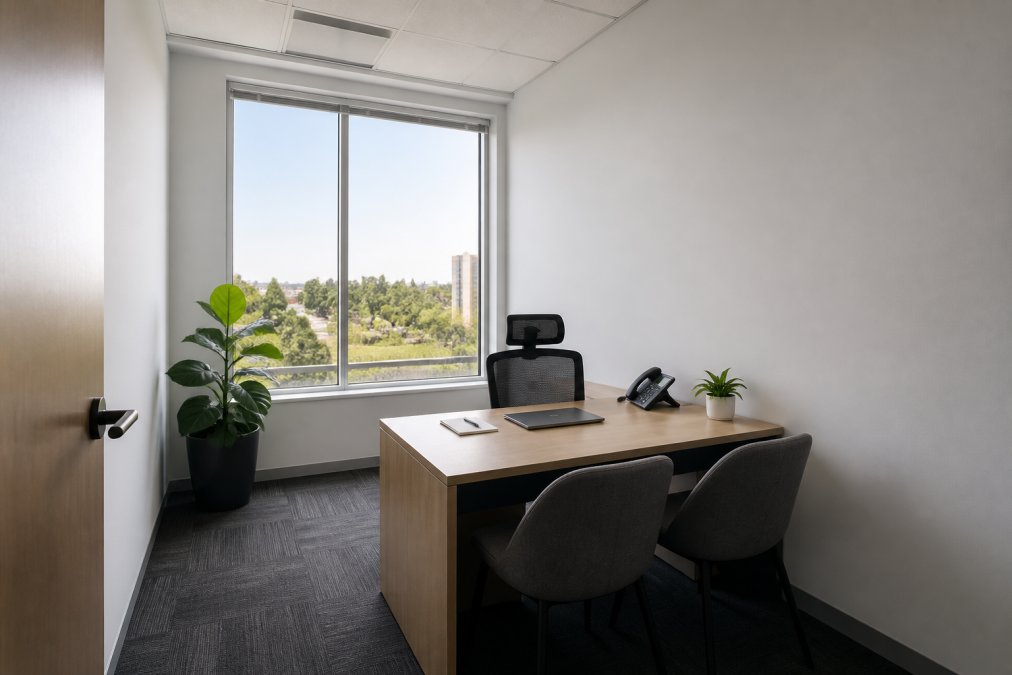
- Solo professional: one private office with room for two guest chairs, commonly in the 100-150 USF range.
- Team of 2-4: two to three private offices plus a shared meeting area, roughly 400-700 USF.
- Team of 5-8: a mix of private offices and open workstations, plus a bookable conference room, roughly 800-1,500 USF.
- Team of 9-15: dedicated collaboration space starts to matter more than individual offices, plan on 1,500-2,500 USF.
Turning Square Footage Into a Per-Seat Budget
Once you have RSF and the quoted rate, the math is straightforward:
- Annual base rent = RSF × rate per RSF.
- Monthly base rent = annual ÷ 12.
- Per-seat base rent = monthly base rent ÷ number of usable seats.
Budgeting the Overhead Around the Space
Rent is the largest line, but not the whole overhead. A realistic office budget also carries payroll for anyone supporting the space, software and phone systems, insurance, and a contingency for reconciliation bills that arrive after year end. A common pattern is holding 10-15% of annual rent in reserve for those surprises, build it in before you sign, not after the first reconciliation lands.
Private Office Lease vs Coworking Membership: Which Costs Less?
A private office lease vs coworking membership comparison usually favors coworking on sticker price and a lease on predictability. A coworking membership bundles utilities, internet, and shared amenities into one recurring fee with a short commitment; a private office lease costs more per month but gives you a defined, exclusive space and control over how it's used.
The decision comes down to three questions:
- Do clients visit your workspace? If yes, privacy and appearance carry real business value.
- How long will you stay? Longer horizons favor a lease; short projects favor membership.
- How much variability can your budget absorb? Memberships can reprice; a fixed lease cannot.
U.S. Small Business Administration guidance on commercial leases
How to Negotiate Office Rent and Avoid Overpaying
Work through this sequence:
- Benchmark the market. Compare at least three comparable suites on price per seat, not just per square foot.
- Ask what's included. Push for utilities, parking, and a meeting room allowance to be bundled rather than billed separately.
- Trade term for rate. If you can commit longer, ask for a lower monthly rate or a rent-free fit-out period.
- Negotiate the escalation clause. Cap annual increases in writing rather than accepting an open-ended formula.
- Clarify exit terms. Ask about subleasing, early termination, and what happens if you outgrow the space.
- Get it in writing. Every concession discussed verbally should appear in the lease agreement.
A tenant who understands total cost has far more use than one haggling over a single line item.
Frequently Asked Questions
How much should you pay for office space?
There is no single number. The cost of dedicated office space depends on location, square footage, lease term, and included amenities. In most U.S. markets, you pay per square foot per year, plus operating expenses. A turnkey private suite bundles utilities, internet, and furnishings into one monthly figure, which makes budgeting simpler. Request quotes from several providers and compare what is included before deciding.
What are the hidden costs of renting office space?
Common hidden costs include CAM charges, utility overages, parking fees, after-hours HVAC, janitorial add-ons, and build-out or restoration obligations. A security deposit and last month's rent are standard. Ask for a full operating expense breakdown before signing, and confirm whether internet, phone, and meeting room access are included or billed separately. These extras can add meaningfully to your monthly overhead.
Is 100 sq ft enough for a private office?
For one person, 100 sq ft is workable if you only need a desk, chair, and small filing cabinet. It gets tight once you add client seating or storage. A practical rule is 100 to 150 sq ft per person, with more for private offices that host meetings. If you expect to grow, choose a suite that allows expansion without relocating.
Does a dedicated office lease include utilities and internet?
It depends on the lease structure. Full-service leases typically cover utilities, janitorial, and sometimes internet, while net leases pass operating expenses to the tenant. Turnkey private office suites usually bundle utilities, high-speed internet, and furnishings into one monthly rate, which reduces surprise costs. Always confirm in writing what is included before you commit.