 blog
Flexible Office Lease for Startups: 2026 Guide
Table of Contents
- Flexible Office Lease for Startups: What It Is and When to Sign One
- Coworking vs. Private Office for Startups: Which Fits Your Team
- Short-Term Office Space for Startups: Month-to-Month and 12-Month Options
- Startup Office Lease Terms to Check Before You Sign
- Flexible Office Space Costs: What Really Hits the Budget
- A Startup Decision Framework: Matching Space to Stage and Headcount
- Conclusion: Choose the Lease That Grows With You
- Frequently Asked Questions
Last Updated: October 5, 2026
Flexible Office Lease for Startups: What It Is and When to Sign One
A flexible office lease for startups is a rental agreement that lets a young company occupy professional workspace on a short commitment, often month to month or under a year, instead of the multi-year contract a traditional commercial landlord expects.
That flexibility matters more than most first-time tenants realize. A traditional lease locks a startup into a fixed term, usually several years, with personal guarantees and steep early-exit penalties.
Below, we break down how flexible office leases work, when they beat coworking, what terms to check, and how to match space to stage.
Coworking vs. Private Office for Startups: Which Fits Your Team
Coworking gives you a desk in a shared room; a private office gives your team a dedicated, lockable suite.
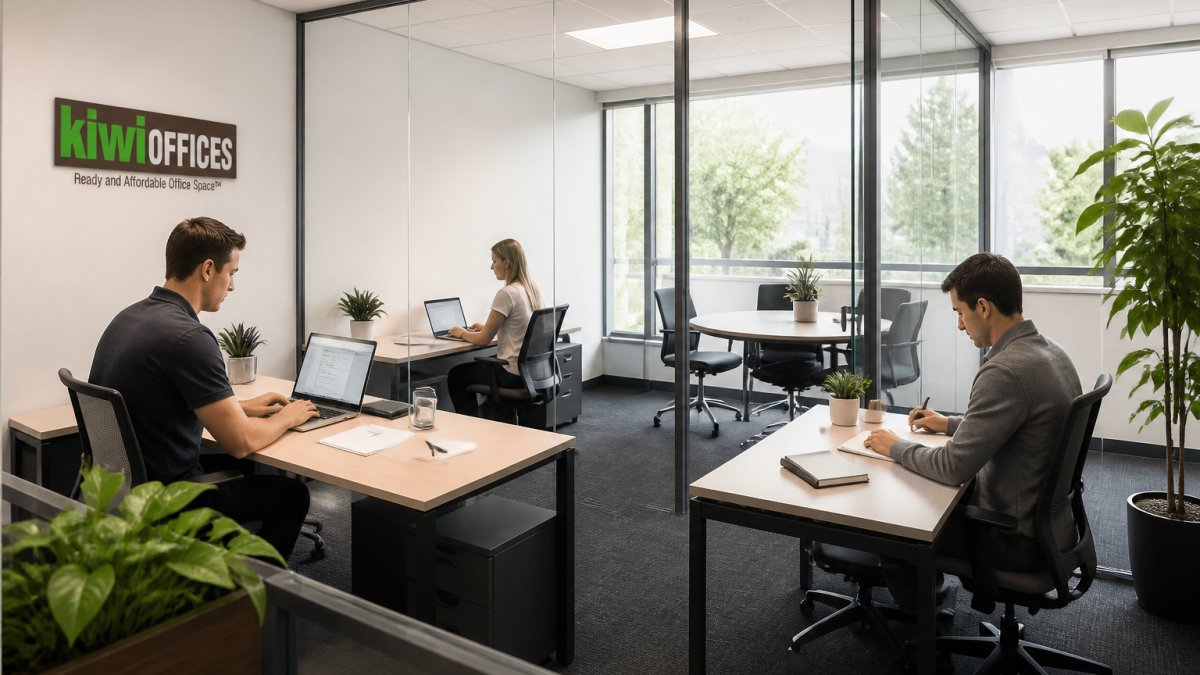
Coworking works well for solo founders and very early teams who want low cost and built-in networking.
A private office suite suits teams that need a quiet, consistent space to host clients and keep conversations confidential.
| Factor | Coworking Desk | Private Office Suite |
|---|---|---|
| Privacy | Shared, open room | Dedicated, lockable |
| Client meetings | Book shared rooms | Meet in your own space |
| Cost | Lowest entry point | Higher, but predictable |
| Scaling | Add desks as needed | Add suites as you grow |
| Best for | Solo founders | Teams of 1-8 |
Short-Term Office Space for Startups: Month-to-Month and 12-Month Options
Short-term office space for startups comes in two forms: rolling month-to-month agreements and fixed terms of six to twelve months.
Month-to-month agreements offer the most freedom. You can leave with short notice, which suits founders still testing a business model.
Twelve-month terms usually lower the monthly rate and lock in your suite, suiting teams with stable headcount and predictable revenue.
- Month-to-month: maximum flexibility, higher rate, short notice to exit
- Six-month term: middle ground, modest discount, one renewal decision
- Twelve-month term: lowest rate, stable space, expansion option worth negotiating
Startup Office Lease Terms to Check Before You Sign
Startup office lease terms decide how much freedom you actually have, so read them before signing. The headline rent rarely hurts; the exit, guarantee, and restoration language usually does. Founders who negotiate these areas avoid the most expensive surprises.
The Clauses That Matter Most
- Lease term and renewal option: how long you are committed and whether you can extend on agreed terms. A pre-agreed renewal rate protects you if the market rises; "fair market value" renewal protects the landlord.
- Early termination and break clause: the notice period and any exit fee. A break clause tied to a fixed date (for example, month twelve) beats one requiring the landlord's consent.
- Personal guarantee: lets the landlord pursue a founder personally if the company cannot pay. Ask whether it can be capped, time-limited, or replaced with a larger deposit.
- Deposit: how much is held, whether it is refundable, and the conditions for return. Confirm whether it can be applied to the final month's rent.
- Expansion option: your right to add suites as headcount grows, ideally at a pre-agreed rate and with a defined notice window.
- Restoration obligations: what you must undo at exit. In a direct lease this can mean removing build-out, patching walls, and returning the space to shell condition, a cost rivaling the deposit.
- Assignment and subletting: whether you can transfer the lease if the company is acquired or pivots. Founders rarely think about this until it matters.
The U.S. General Services Administration's lease guidance explains how commercial lease clauses are typically structured, which helps you spot the ones worth negotiating.
Negotiation Checklist: Clauses That Protect a Growing Team
Use this checklist before you sign:
- Confirm the lease term and exact renewal terms in writing
- Ask for a break clause with a defined notice period and a fixed break date
- Clarify the deposit amount, return conditions, and whether it applies to the final month
- Ask whether the personal guarantee can be capped, time-limited, or waived in favor of a larger deposit
- Secure a written expansion option for additional suites at a pre-agreed rate
- Confirm restoration obligations in writing, including who pays for what at exit
- Confirm assignment and subletting rights in case of acquisition or pivot
- List everything included: furniture, internet, utilities, meeting rooms
How to Negotiate as a Small Tenant
Landlords negotiate more than founders expect, especially in soft markets or on vacant suites. The levers for a small team differ from a large tenant's:
- Trade term for concessions. Accept a twelve-month term instead of month-to-month and ask for a lower rate, reduced deposit, or free month.
- Trade deposit for guarantee relief. A larger refundable deposit is often easier for a landlord to accept than removing a guarantee.
- Ask for a phased expansion right. A right of first refusal on adjacent suites costs the landlord little and protects you as you grow.
- Get everything in the lease, not in email. Verbal promises about parking, signage, or expansion do not survive a change in building management.
The first offer is a template, not a floor. Founders who ask for a break clause and expansion option in the first conversation usually get at least one.
Flexible Office Space Costs: What Really Hits the Budget
Flexible office space costs more per square foot than a traditional long-term lease, but total occupancy cost often comes out lower for a startup because you skip the fit-out, furniture, and long commitment a direct lease demands. Most founders err by comparing headline rent instead of the full twelve-month cost.
Total Cost of Occupancy: The Line Items That Decide the Winner
Build your comparison around every dollar that leaves the business, not just rent. These categories most often flip the decision.
- Base rent or membership fee: quoted monthly, but confirm whether it is per desk, per suite, or per square foot.
- Security deposit: traditional leases commonly ask for one to three months of rent; flexible and serviced agreements often ask for one month or a flat fee.
- Fit-out and furniture: a direct lease delivers bare space. Desks, chairs, conference tables, and build-out can run into tens of thousands before anyone sits down; turnkey suites bundle this.
- Utilities, internet, and janitorial: frequently bundled in flexible agreements and billed separately in direct leases.
- Insurance: general liability and, for direct leases, often a certificate naming the landlord as additional insured.
- Parking and after-hours HVAC: commonly metered or billed as add-ons in both models.
- Service charges and CAM (common area maintenance): in direct leases these can escalate annually and are easy to underestimate.
- Exit costs: early termination fees, restoration obligations, and the cost of unused months on a direct lease.
A Side-by-Side Comparison of Lease Models
Use this matrix to compare the four models founders choose between. No model wins everywhere; the trade-offs shift with runway and headcount.
| Factor | Coworking Membership | Serviced / Flexible Suite | Sublease | Direct Lease |
|---|---|---|---|---|
| Typical term | Month to month | 1-24 months | Remaining term of master lease | 3-10 years |
| Upfront cost | First month + small deposit | First month + deposit | Deposit + possible consent fees | Deposit + first month + build-out |
| Furniture | Included | Included | Often included | Usually your cost |
| Privacy | Shared | Private, lockable | Varies | Full control |
| Setup effort | Hours | Days | Weeks | Months |
| Flexibility to exit | Highest | High | Low to moderate | Lowest |
| Best fit | Solo founder, pre-revenue | Small team needing a real office | Team that needs cheap space fast | Funded team with predictable headcount |
What Actually Drives the Monthly Number
Three variables move the price most: suite size, term length, and what is bundled. A twelve-month term on a two-person suite with furniture and internet usually prices lower per seat than a month-to-month desk once you add coworking extras.
Because pricing depends on suite size, term length, and what is included, we do not publish flat rates. The honest answer is that your monthly cost varies with your team size and lease term, so the IRS guide to deductible business expenses is worth a look when you plan how to treat occupancy costs at tax time.
A Startup Decision Framework: Matching Space to Stage and Headcount
Match your space to your stage, not your ambition. A framework beats guesswork when choosing between a desk, a suite, and a traditional lease.
- Solo founder, testing an idea: coworking desk or virtual office for the address
- Team of 1-3, meeting clients: private suite on a month-to-month flexible office lease
- Team of 4-8, stable revenue: private suite on a twelve-month term with an expansion option
- Team scaling past 8: multiple suites or a larger space, negotiated with a phased occupancy plan
This is where Kiwi Offices fits. We provide turnkey furnished offices and private individual business suites for small teams, not shared coworking space. You get a ready-to-use, furnished environment and your own dedicated workspace, so you can move in fast without a fit-out project.
Conclusion: Choose the Lease That Grows With You
The hardest part of leasing as a startup is predicting your own growth. A flexible office lease for startups solves that by letting you commit short-term while keeping the option to expand.
If you need a private, turnkey office without a long-term commercial lease, Kiwi Offices offers furnished individual business suites with a professional setting and the independence small teams need.
Frequently Asked Questions
What is a flexible office lease for a startup?
A flexible office lease is a short-term rental agreement, often month-to-month or 6 to 12 months, that gives a startup a private office without the multi-year commitment of a traditional commercial lease. It usually includes furniture, utilities, internet, and shared amenities in one monthly payment. For founders who expect headcount to change, the shorter term and expansion options matter more than the lowest per-square-foot rate.
How long are flexible office leases?
Most flexible office leases run month-to-month or for 6 to 12 months, compared with the 3 to 10 year terms common in traditional commercial leases. Shorter terms usually cost more per month, but they limit your exposure if the team doubles or shrinks. Ask about renewal options and whether you can move to a larger suite mid-term without paying a penalty.
What costs should startups check before signing an office lease?
Beyond monthly rent, ask about the security deposit, parking, utilities overages, internet upgrades, meeting room fees, and any build-out or furniture charges. A turnkey private suite bundles most of these, so your occupancy cost is closer to the quoted number. Request a written list of what is included and what is billed separately before you sign.
Can a startup negotiate a short-term office lease?
Yes. Landlords and office providers often have room to negotiate on lease term, deposit size, renewal options, and expansion rights, especially for suites that have been vacant. Come with a clear headcount plan for the next 12 months and ask for a break clause that lets you exit early with 30 to 60 days notice. Get every concession in writing.