 blog
blog
Small Office Space for Rent: What to Know in 2026
Table of Contents
- What Small Office Space for Rent Actually Costs
- Types of Small Office Space: Coworking, Executive Suites, and Private Suites
- Private Office Suites for Small Business: Who They Fit Best
- How to Choose the Right Office Size for Your Team
- Short Term Office Lease Agreements vs Long Term Commitments
- Hidden Costs of Office Leasing and How to Negotiate
- Frequently Asked Questions
Last Updated: September 14, 2026
What Small Office Space for Rent Actually Costs
Pricing for small office space for rent depends on location, suite size, lease length, and what the landlord bundles into the rate. Expect to pay base rent plus a separate operating expense charge, and ask for a full cost breakdown in writing before signing.
Pricing for small office space for rent is a common question. Here is how the math works, including the line items most listings never show.
Average Rental Rates per Square Foot
Commercial rents are quoted per square foot per year, not per month. A modest per-foot rate can look affordable until you multiply by square footage and divide by twelve.
Rates swing widely by submarket, building class, and whether the space is move-in ready or raw shell. A furnished suite in a professional business center carries a higher per-foot rate than an unfurnished older property, but it eliminates furniture, buildout, and utility setup costs.
Ask every landlord for three numbers: base rent per square foot, the operating expense charge, and any gross-up or escalation clause. According to U.S. Small Business Administration guidance on commercial leases, tenants should review escalation terms carefully because they determine how much rent rises over the term.
The Cost Mechanics Landlords Rarely Explain Up Front
Two quotes with the same headline rate can produce very different monthly bills. The difference lives in four mechanics:
- Load factor (rentable vs. usable square footage). You pay on rentable square feet, including your share of lobbies, hallways, restrooms, and mechanical rooms. A 1,000-square-foot usable suite at a 15% load factor bills as 1,150 rentable square feet. Ask for both numbers.
- CAM (Common Area Maintenance) charges. In a net lease, you reimburse your share of property taxes, insurance, landscaping, snow removal, security, and building repairs. CAM adds meaningfully to effective rent and is usually estimated at signing and reconciled at year-end.
- Base year and gross-up. In a full-service gross lease, rent includes operating expenses up to a "base year" amount; costs above it pass through to you. A gross-up clause adjusts the base year to reflect full occupancy, which can raise your pass-through exposure.
- Escalations. Annual increases of a fixed percentage or tied to the Consumer Price Index are standard. A 3% annual bump on a five-year term compounds to roughly 16% above the starting rate by year five. Model it before you sign.
What's Included in the Monthly Rent
Inclusions vary enormously, and this is where similar quotes diverge. A full-service gross lease folds utilities, janitorial, and building maintenance into one payment; a net lease pushes some or all of those costs to the tenant.
Common inclusions in a turnkey furnished suite:
- High-speed internet and utilities
- Furniture, desks, and seating
- Meeting rooms and shared common areas
- Reception and mail handling
- Parking availability, sometimes at an added monthly rate
- Janitorial service for common areas
"All-inclusive" rarely means everything. Confirm whether after-hours HVAC, additional parking, and signage carry separate charges.
Hidden Costs That Blow the Budget
Beyond base rent and CAM, budget for:
- Security deposit, often one to three months of gross rent, possibly held for the full term.
- Tenant improvements (TI), raw or reconfigured space may require you to fund the buildout or negotiate a TI allowance.
- After-hours HVAC, many buildings bill overtime HVAC hourly outside standard business hours.
- Parking, reserved spaces are frequently billed monthly per stall, separate from rent.
- Signage and directory listing, monument signage and lobby directory placement often carry a fee.
- Restoration obligations, some leases require returning the space to original condition at move-out, including removing improvements you paid for.
- Insurance, commercial general liability and contents coverage are typically required, with the landlord named as additional insured.
Types of Small Office Space: Coworking, Executive Suites, and Private Suites
The three main formats serve different needs, and choosing wrong is expensive. Coworking sells flexibility and community in an open shared workspace. Executive suites offer a private, lockable office inside a managed business center with shared reception and conference rooms. Private suites give a business dedicated, fully furnished space with a closed door and controlled access.
| Format | Privacy | Typical Lease | Best For |
|---|---|---|---|
| Coworking | Open desk, shared | Month to month | Solo workers, heavy networking |
| Executive suite | Private room, shared amenities | Short to medium term | Small teams needing a professional address |
| Private suite | Fully private, dedicated | Flexible to long term | Client-facing businesses needing confidentiality |
Coworking suits someone who rarely takes calls and wants company, but works poorly for a consultant meeting clients face to face who needs a quiet, confidential room.
Executive suites sit in the middle: a real door and professional environment, but shared reception, meeting rooms, and kitchen facilities. Private suites suit businesses that treat their office as a client-facing asset.
Private Office Suites for Small Business: Who They Fit Best
Private office suites for small business fit teams of one to eight people who need a dedicated, quiet workspace, a professional business address, and the ability to meet clients without booking a room elsewhere. They suit consultants, contractors, attorneys, accountants, and satellite teams that must look established from day one.
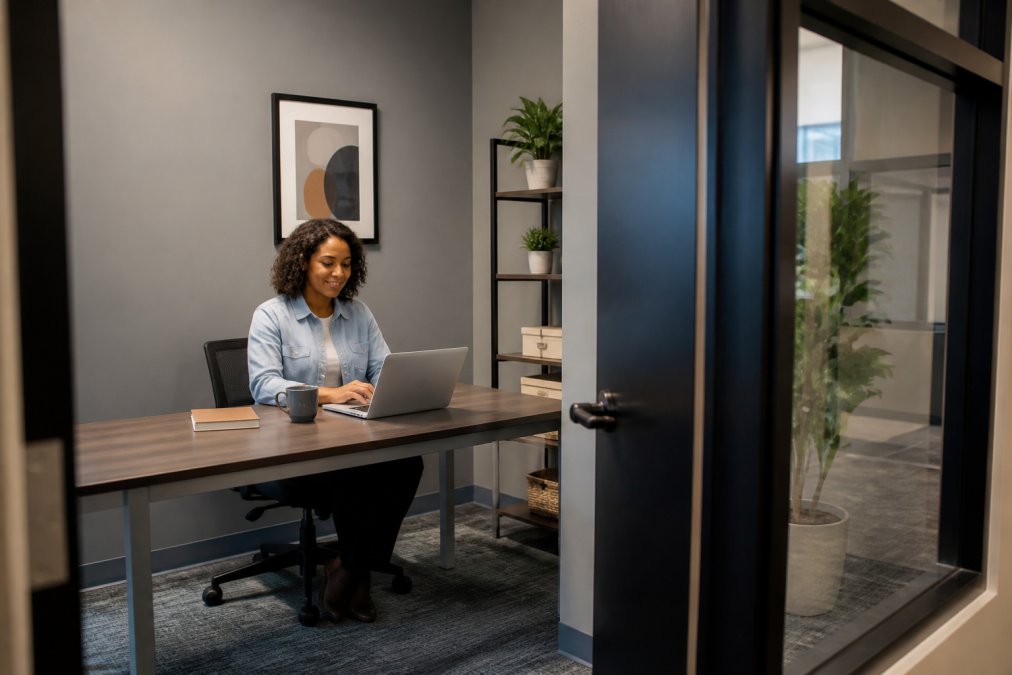
The honest case for a private suite over the spare bedroom is separation, not comfort. When home doubles as the office, clients sense it, family interrupts calls, and work-life boundaries erode. A dedicated office changes how you operate and how prospects perceive you.
Kiwi Offices provides professional, turnkey furnished office spaces designed specifically for small businesses. Unlike co-working or shared environments, we offer private, individual business suites that give you the independence you need to thrive. The difference from a shared-workspace desk is control over who is in the room during a client call.
How to Choose the Right Office Size for Your Team
Choosing the right office size comes down to headcount, how often people are on site, and how many meeting or focus spaces you need. Measure usable square footage against your actual weekly pattern, not your worst-case scenario, and leave room to grow.
Square Footage Rules of Thumb by Headcount
A common planning range is roughly 100 to 150 square feet per employee in a traditional setup, less in a dense or hybrid configuration with shared desks (Occupancy and utilization reporting guidelines). Private offices push the number higher.
| Team Size | Typical Range | Notes |
|---|---|---|
| 1-2 people | 100-250 sq ft | Single private office |
| 3-4 people | 300-500 sq ft | Two offices or open area plus one private room |
| 5-8 people | 500-900 sq ft | Multiple offices, small meeting area |
If you expect to grow, ask whether adjoining suites are available.
Short Term Office Lease Agreements vs Long Term Commitments
The Lease Terms That Actually Control Your Flexibility
How Hybrid Work Changes the Math
A practical approach for hybrid teams:
Negotiation Levers for Short and Long Terms
Hidden Costs of Office Leasing and How to Negotiate
Site Visit Checklist Before You Sign
Use this checklist on every tour:
Frequently Asked Questions
How much does it typically cost to rent a small office space?
Rates depend on location, suite size, and lease length, so there is no single figure. In most U.S. markets, small private offices bill monthly per square foot, with executive suites and turnkey furnished spaces priced higher than bare commercial space because furniture, utilities, and internet are bundled in. Ask any provider for a written breakdown of what the monthly rent covers before you compare quotes.
Are utilities and internet usually included in small office rental agreements?
It varies. Many turnkey and executive suite providers fold electricity, HVAC, high-speed internet, and janitorial service into one monthly figure, while traditional commercial leases often pass those through as additional charges. Always confirm in writing whether the quoted rent includes utilities, internet, parking availability, and access to meeting rooms, or whether those are billed separately.
What lease terms are standard for small business office rentals?
Traditional commercial leases commonly run three to five years, while executive suites and shared workspace providers often offer month-to-month or six-month terms. Short term office lease agreements give small teams flexibility to scale up or down without a long commitment. If you expect headcount to change, ask whether you can expand into a larger suite mid-lease without penalty.
How can I determine the right office size for my team's needs?
A common planning rule is 100 to 150 square feet per employee for a private office, plus extra room for a reception area or meeting space. A team of four typically fits comfortably in 400 to 600 square feet. Count private offices, shared desks, and client-facing space separately, then add 10 to 15 percent as buffer for growth before you commit to a suite.